Commercial & Office Movers in Wichita Falls, TX
Wichita Falls Texas Movers moves businesses around Wichita Falls, the Wichita County seat: offices, professional practices, retail units and warehouses. A sound plan works around your closing hours instead of cutting through the middle of your week, with trading essentials leaving last and arriving first. Send the two addresses, a headcount, and the date you must be up and running, so the schedule can be built around those.
Sites that move
Offices and professional firms
Law, accounting, finance, advertising, consulting firms.
Clinics: medical, dental and veterinary
Equipment and patient files both call for extra care.
Shops and showrooms
Shelving, inventory, displays and checkout gear.
Warehouses and small plants
Pallet racks, goods, benches and machinery.
Restaurants and professional kitchens
Ranges, prep tables, shelving and supplies, timed around service instead of cutting into it.
Schools, churches, societies and charities
Classrooms, halls, offices and storerooms, often fitted into a break between terms or a slow week.
One department, one floor, or a rearrangement within a building
Clearing two floors, then bringing it all back once new carpet is down.
Computer rooms, network gear and file archives
Alongside a bigger move, or by themselves.
Relocating a home, not a company? Look at residential moving, which follows a different kind of plan.
Lost trading time costs most
Hauling the furniture is seldom the costly piece of an office move. What hurts is each hour the business sits idle, and a commercial move is built around limiting that.
That calls for sequencing more than speed. Whatever you cannot operate without is identified first and moved last, keeping it offline briefly. IT typically leaves at the end of the old site's last day and goes in first at the new one. Teams able to work from anywhere for a day move early. Larger firms often relocate in phases over several visits instead of all at once, which adds a few trips and spares a great deal of lost trading time across the whole project.
None of it falls into place on the day itself; it comes from walking through both premises ahead of time.
Jobs to finish ahead of moving day
When an office move fails, the cause is nearly always the preparation, not the carrying:
Have internet and phones active at the new site before the move, not afterward.
Installing business connections at a new address often takes longer than expected, which is the most frequent reason a company moves without a hitch yet cannot trade on Monday. Order it the same week the lease is signed, not once the boxes are packed.
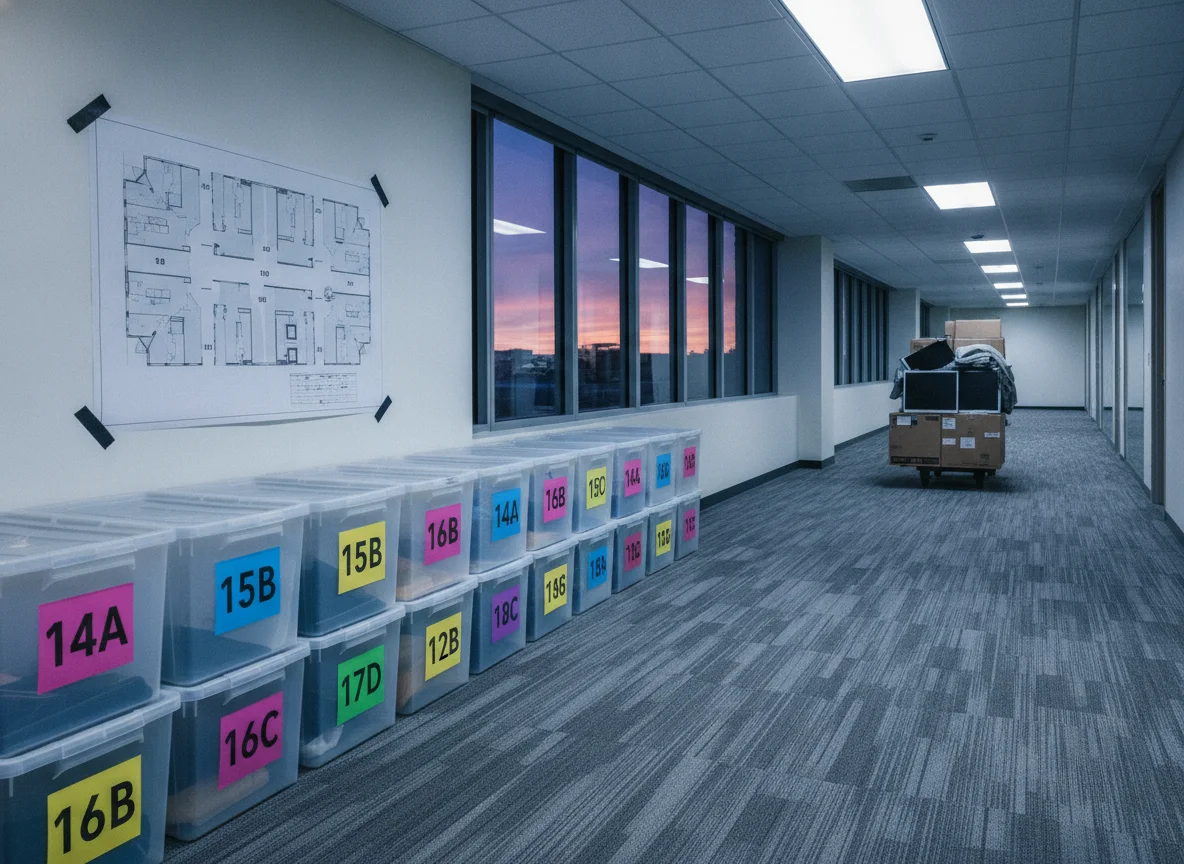
A numbered layout of the new floor.
Each desk, office and storage area gets a label, so no one makes decisions in a hallway with staff standing by.
One labeling scheme for all.
Give each destination room a number or a color, mark every carton and furniture item with it, and tie it to the plan posted at the new location.
A single contact person at each site.
A person empowered to answer questions and decide on the spot, at the old address and the new.
Employees box up their desks.
Each person gets one crate marked with a name and the new desk number, and personal items and valuables go home instead. It moves faster, stays tidier, and everyone can find their own things afterward.
Written access instructions.
Who unlocks and who secures, alarm codes, keys, parking, and any limits on the hours work is allowed in the building.
Contact both landlords soon.
Many buildings require notice and paperwork from whoever is moving before work may begin. Find out what is needed well before the date, since a gap in that paperwork is slow to fix during the last week.
Technology and equipment with special rules
Complete a full backup ahead of any unplugging.
Any relocation puts data at slight risk, and a current backup is what takes that risk off the table.
Take photos of the rear of each server rack and workstation
Do it before one cable is pulled; a few minutes of pictures spares hours of guesswork.
Each cable goes in a bag marked with the machine it came off
Never one communal box. Monitors ride upright in screen cartons, and towers go in boxes instead of loose.
Shutting down and restarting servers and network gear belongs to your IT provider or a specialist
They power systems off cleanly and restore them in the proper sequence. Movers carry the hardware, while configuration is not moving work and should not be handed to them.
Read the lease on each copier or multifunction printer before it is moved.
Leasing companies commonly insist on moving their own machines with their technician, and handling one yourself may breach the contract or end the service coverage. Arrange that separately and early.
Safes, fire-rated filing cabinets, heavy machines
These call for proper gear and enough hands, and sometimes a look at what weight the new floor can bear. Raise them at the start, not the end.
Specialty machines in medical, dental, lab, kitchen and gym settings —
Frequently comes with maker or vendor rules on disconnecting, transporting and recalibrating it. When those apply, the vendor's technicians do that part, not the movers.
Cubicles, desks and furniture systems
Cubicle and partition systems can be taken apart and rebuilt, but they are not interchangeable: panels, connectors and hardware match a specific system, and a layout that suited the old space may not reconfigure neatly on a new floor plan. Confirm what you own and what the new space can accept before assuming the whole system comes along.
Height-adjustable desks, conference tables, filing systems and racking also come apart and go back together. Whatever the item, the fittings stay bagged and attached to the piece they came off, because a partition wall without connectors is scrap.
Files and sensitive material
Client files, personnel records, and medical and financial documents should travel sealed, numbered and tracked at both ends, so nothing sits unattended and nothing turns up unexplained. If regulations apply to your records, state what they are before the move so the plan can account for them; that discussion belongs in planning, not on the day.
Whatever you would prefer never left the premises should ride along with one of your own employees.
Handing back the old space per your lease
Most commercial leases demand that the space be returned in a set condition, and that duty is easy to forget until the last week. Fixed shelving, wall brackets, signs and cabling generally have to come out, and whatever remains needs somewhere to go. Old furniture, dead IT equipment and archive boxes that are not making the trip each need their own disposal plan.
Bring it up while planning. Handled with notice it is simple, and rushed it gets costly.
What drives the cost
Cost follows the volume going, how much is taken apart and rebuilt, the IT and specialist equipment involved, how hard each building is to load and unload, a single visit versus several, whether work falls inside or outside your operating hours, and how much of the old space needs clearing. Texas movers must give a written proposal before loading, according to the Texas Department of Motor Vehicles. For anything handled in-house, loading and unloading help covers lifting while your staff manage the rest.
Business relocations extend from Pleasant Valley and Lakeside City across Wichita Falls to Iowa Park, Holliday, Burkburnett, Dean and nearby communities.
Questions answered
Can the business stay open?
Often, yes. Phased moves and moves timed around your operating hours exist so a business need not shut down. It takes more planning and sometimes extra trips, and is generally worth the effort.
Who unplugs the computers?
Your IT provider or a specialist covers the shutdown, the network, and bringing systems back online, while movers carry the physical hardware. Settle who does which before the day, because "I assumed you were doing it" is how a business loses a morning.
How early should we begin preparing?
Sooner than for a house move, because connectivity, landlord paperwork and vendor equipment set the pace. Oklahoma is about 15 miles north, and a move across the line needs interstate authority; see the Federal Motor Carrier Safety Administration.
Is packing part of the service?
Yes: packing services covers a full pack, or only what staff would rather not touch, such as a records room or kitchen. Most businesses let employees pack their own desks and pass the remainder along.
Ready to scope the job?
Share both addresses, an approximate count of people and workstations moving, the target date, and anything specialized on site, such as servers, a safe, medical or lab equipment, or a leased copier. Walking through both premises is what turns that into a plan.